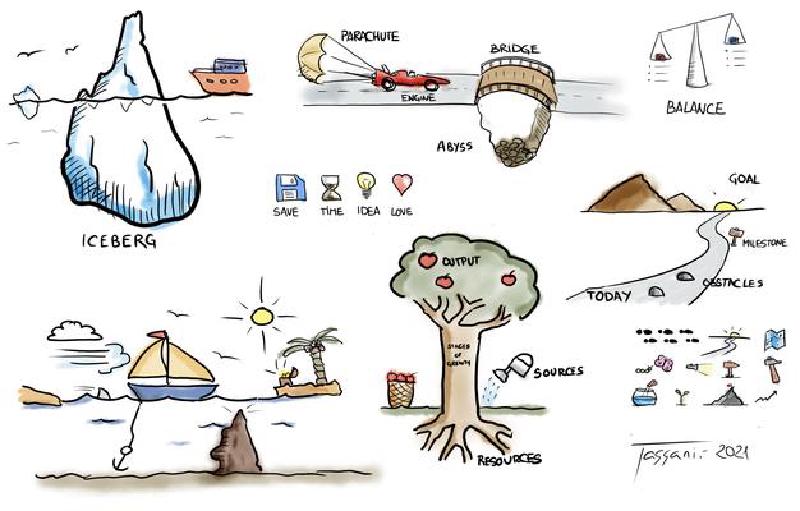
A metaphor is a figure of speech that refers to one thing by mentioning another. “The world’s a stage”.
A simile is similar to a metaphor but using the words “like” or “as”. “Life is like a box of chocolates”.
An analogy is also similar but more complex because rather than a figure of speech, it is a logical argument: “Finding my keys is like finding a needle in a haystack”.
These resources can be used to explain a point, to simplify understanding. They use previous knowledge from the recipient, a listener or a reader, to describe an object or an action in a way that is not literally true. Metaphors have a stronger effect because they do a direct comparison. We replace one object with the other and we feel clear connections.

When we replace one object with another because they have certain similarities, we obviate their differences. We can focus on the aspects that were conveying the explanation but the differences may still influence us. That extra baggage goes unnoticed and it may affect our relationship with the new object.
Finding the right analogy to explain a complex topic is an art and some people are very good at it. Some metaphors that work for a certain audience don’t work for other people, or may have the opposite effect. And some metaphors are so embedded in our culture that we are not aware of them. How are they influencing us?
We are going to explore the use of metaphors in software, visual facilitation and everyday language. I will use the terms “metaphor” and “analogy” in a loose way, meaning the use of a term without its literal meaning.
In software
Steve McConnell in Code Complete explores the idea of metaphors to better understand software development. He says we can benefit from them to give insight into problems and processes.
McConnell suggests software is “writing” and “farming”, but he prefers “construction” [1, p. 9]. The images of “building”, “scaffolding”, “architects”, “planning”, “blueprints”, “patterns” or “façade” are widespread in our industry (if you allow me the metaphor).
Kent Beck criticises the construction metaphor in Extreme Programming Explained [2, p. 104] arguing that it is extremely difficult to reverse progress in the construction world and discussing the importance of when to design.
Beck also compares Extreme Programming to driving a car [2, p. 12]: customers drive the content of the system and the whole team drives the development process. Alistair Cockburn says software is a cooperative game. Eric Raymond a bazaar.
We use the metaphor of space when talking about the Internet with terms such as “locations”, “communication roads”, “cyberspace”, “visiting”, “finding”, or “the information superhighway”.
Ward Cunningham introduced the financial analogy of the technical debt.
In interaction design, the desktop metaphor has been with us since created in 1970 at Xerox PARC. It uses files, folders, windows, forms, a desk, and a trash can.
The analogy of naming servers after “cattle not pets” used in DevOps also uses previous knowledge and makes its point clear. Like the “coal mine canary” does.
Cybersecurity uses metaphors about burglars and treasures, always talking about protecting a space. Common terms are “attack”, “walls”, “locks”, “keys”, “doors”, or “vaults”. Some have suggested a pest metaphor [3], an immune system or a medical health metaphor [4]. Would we approach cybersecurity in a different way using them?
Map, resource pool, web, queue, stack, index, tree, package, library, object, label, cookie, fork, branch, sandbox, triggers, semaphore, filter, and pipe are other words we use to refer to abstract concepts in software [5]. Probably, the level of abstraction we use makes metaphorical language a necessity.
Can you think of other metaphors used in software?
In graphics and facilitation
When doing visual facilitation or visual recording, metaphors come in handy. Sometimes the actual narrative contains an explicit metaphor that just needs to be visualised. Other times the facilitator or the visual recorder create a metaphor to describe the content. Dave Sibbet in Visual Meetings [6, p. 42] suggests different options, and in The world of visual facilitation [7, p. 294] they also explore their use in multicultural environments.
Some of the metaphors I’ve seen are “the iceberg”, “the journey”, “climbing the mountain”, or “the bridge”. The iceberg is used to describe hidden risks or obstacles. The journey is handy to describe a long story with events and an end goal. The mountain serves a similar purpose but expressing the difficulties or the challenge. The bridge allows us to describe a solution with the previous and future, or current, state.
More creative recorders add more art to their work and invent ad hoc metaphors to every sketchnote or visual recording.

In team retrospectives, there are a few visual metaphors that have been used for a long time, because they help teams discuss events from multiple angles maintaining a certain emotional distance. For instance, the saliboat retrospective allows participants to put post-its on the items they think are giving energy and moving them forward, putting them on the wind or on the sails. They can reflect on things that slow them down putting items on the anchor. They can discuss their past putting notes on the island behind or on their future, with the island on the right. They can comment on risks with the sharks or the rocks. And they can be very creative adding whatever they want to the picture. I’ve seen pirates, cannons, ice cream, UFOs and hammocks!
You get the idea about triggering the conversation thanks to the metaphor and you don’t need a fancy visual to have it started. I’ve seen teams asking “if our last iteration was a football match, who was our goalkeeper? What was the controversial play? Who was our best supporter?” and so on.
In everyday language
Future is ahead or behind? Probably you will think that the future is ahead of you and your past is behind you, but there is no real relationship between time and direction. For the speakers of Aymara (spoken in Peru), looking ahead is looking at the past [8]. You have already experienced the past, it is known, you can see it as anything you see, in front of you. Mandarin Chinese speakers use up and down gestures to refer to time. Up is the past, down is the future.
George Lakoff and Mark Johnson, researchers of cognitive science and linguistics, state in Metaphors we live by [9] that the way we create concepts is metaphorical in nature. The way we think is based on metaphors: we try to understand and experience in terms of another thing we know. They add that some metaphors are completely arbitrary and part of our culture, and they shape the way we think.
Take the following conceptual metaphor: an argument is a war. With that idea these expressions come naturally:
- He attacked every weak point in my argument.
- Your claims are indefensible.
- She shot down all my arguments.
What if we had a culture where an argument is a dance? Imagine we expect participants as performers, and the goal is to perform in a balanced and aesthetically pleasant way. We would see arguments in a very different way.
There are many ingrained metaphors, some of them shared across languages.
- Happy is up; sad is down (I am feeling down)
- More is up; less is down (His income fell last year)
- High status is up; low status is down (He’s climbing the ladder)
- The mind is a machine (He broke down)
- Love is a journey (We are at a crossroads)
- Understanding is seeing (It is clear now)
As these metaphorical constructions are coherent, metaphors make us fit new events into their explanation, reinforcing its power and creating a self-fulfilling prophecy.
Consequences
Replacing an already existing and accepted metaphor may be nearly impossible, but we can start paying attention to them, and assessing if they are affecting our underlying beliefs. When we create an analogy, we can pay attention to the extra impact it can add.
Take “maturity”, for instance. When we consider the assessment of the way we work under the lens of “maturity” we escape from the possibility of reducing the rate because things don’t “unmature”: there is only one direction, never going back.
Is there any other metaphor conditioning you?
Toni Tassani — 10 Mar 2026
This article was originally published on 17 May 2021 on the Ocado Technology intranet.
[1] Steve McConnell, Code Complete, 2nd ed. Redmond, Wash: Microsoft Press, 2004.
[2] Kent Beck and Cynthia Andres, Extreme Programming Explained: Embrace Change. Boston, MA: Addison-Wesley, 2004.
[3] Storro, “Lessons from pest control,” Medium, 25-Jan-2019. [Online]. Available: https://medium.com/storro-blog/buislessons-from-pest-control-why-the-popular-metaphors-in-cybersecurity-are-broken-88d15191d766. [Accessed: 05-May-2021]
[4] Judy Hennessey Moore, Lori K. Parrott, and Thomas H. Karas, “Metaphors for cyber security.” SAND2008-5381, 947345, Aug. 2008 [Online]. Available: http://www.osti.gov/servlets/purl/947345-IFQISp/. [Accessed: 05-May-2021]
[5] Nikolas S. Boyd, “Software Metaphors,” 2003. [Online]. Available: http://www.educery.com/papers/rhetoric/metaphors/. [Accessed: 05-May-2021]
[6] David Sibbet, Visual Meetings: How Graphics, Sticky Notes and Idea Mapping Can Transform Group Productivity. Hoboken, N.J: John Wiley & Sons, 2010.
[7] Jeroen Blijsie, Tim Hammons, and Rachel Smith, Eds., The World of Visual Facilitation: Unlock Your Power to Connect People and Ideas. Nijkerk: The Visual Connection Publishers, 2019.
[8] Panos Athanasopoulos and Mignon Fogarty, “748: Language Alters Our Experience of Time,” [Audio podcast], Grammar Girl - Quick and Dirty Tips, 12-Dec-2019. [Online]. Available: https://www.quickanddirtytips.com/education/grammar/language-alters-our-experience-of-time. [Accessed: 26-Apr-2021]
[9] George Lakoff and Mark Johnson, Metaphors We Live by. Chicago, Ill: University of Chicago Press, 2017.